
TOPABEL KNOWLEDGE SERIES / 04
Fluorescence, glow in the dark and reflection: what makes each look bright?
Fluorescent materials emit light while being excited. Glow-in-the-dark materials can continue to emit light for a time after exposure. Reflective surfaces return incoming light, with retroreflective surfaces directing much of it back toward the source.
Know the formats · About 3 min read
Follow the light in each panel
Compare the lamps and material swatches from left to right. On the left, an ultraviolet lamp excites the fluorescent swatch. In the middle, the lamp is off and the glow material still emits light. On the right, a flashlight near the camera illuminates a retroreflective surface.
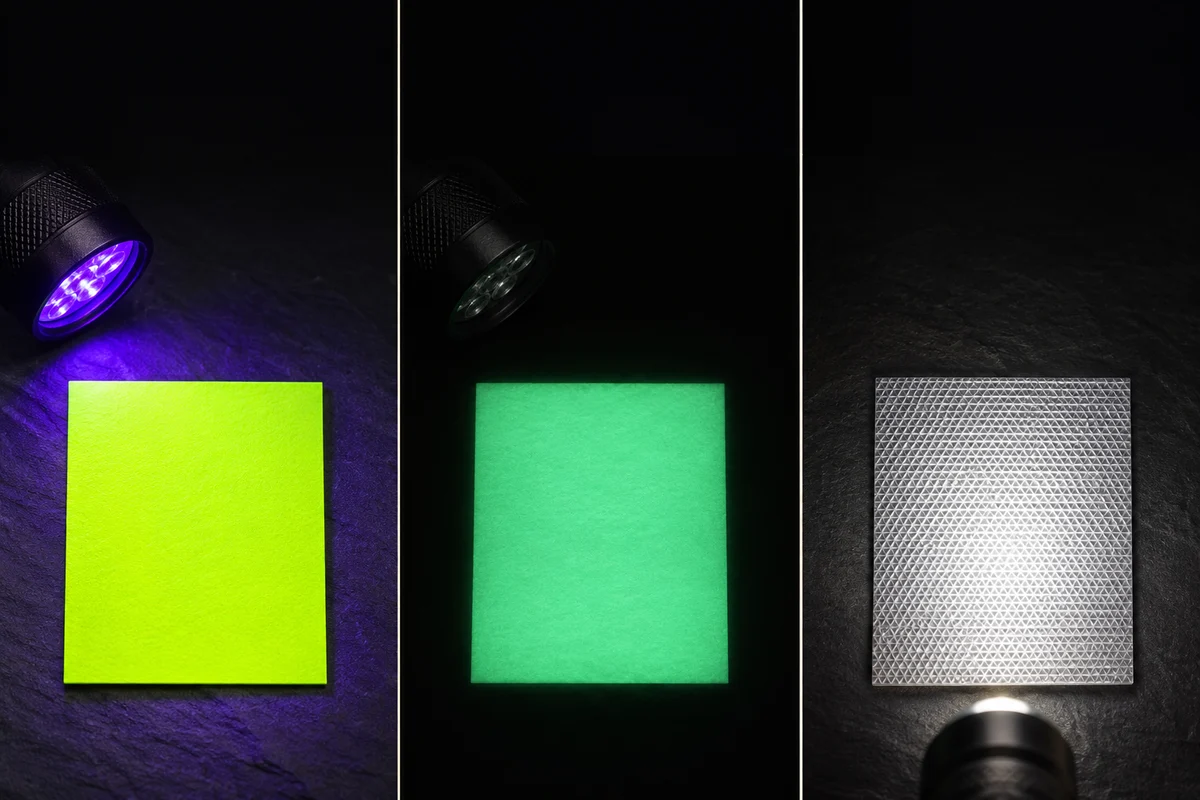
- Fluorescence under excitation
- Afterglow with the lamp off
- Retroreflection toward the source
AI-generated illustrations of lighting conditions. Brightness is illustrative.
Separate light emission from reflection
A fluorescent dye absorbs suitable light and emits some energy as light at a different wavelength. The fluorescent contribution fades very quickly when excitation stops. In a typical glow-in-the-dark material, energy absorbed during exposure is released more gradually, so the afterglow gets dimmer with time.
Read a bright photo in context
A bright patch in a photo could come from illumination, a material effect or camera settings. For a reflective material, note where the lamp and viewer were positioned. For afterglow, note the exposure conditions and the time since the light was removed.
Quick questions
Does a fluorescent colour stay bright in the dark?
Fluorescence requires excitation. The visible glow after the light is removed is a different phenomenon called afterglow.
Why can two observers see different levels of reflection?
Lighting and viewing geometry matter. With retroreflection, an observer near the source usually sees a stronger return than one far to the side.