
TOPABEL KNOWLEDGE SERIES / 07
Paper grammage, thickness and stiffness: what does each tell you?
Grammage is mass per unit area, thickness is the distance between the two faces, and bending stiffness is resistance to bending. Paper of the same grammage can differ in both thickness and stiffness.
Read the specifications · About 3 min read
Three measurements, three questions
The scale compares mass for a known area. The middle panel shows the thickness of a sheet in cross-section. On the right, two samples with the same overhang are shown bending differently under the same load.
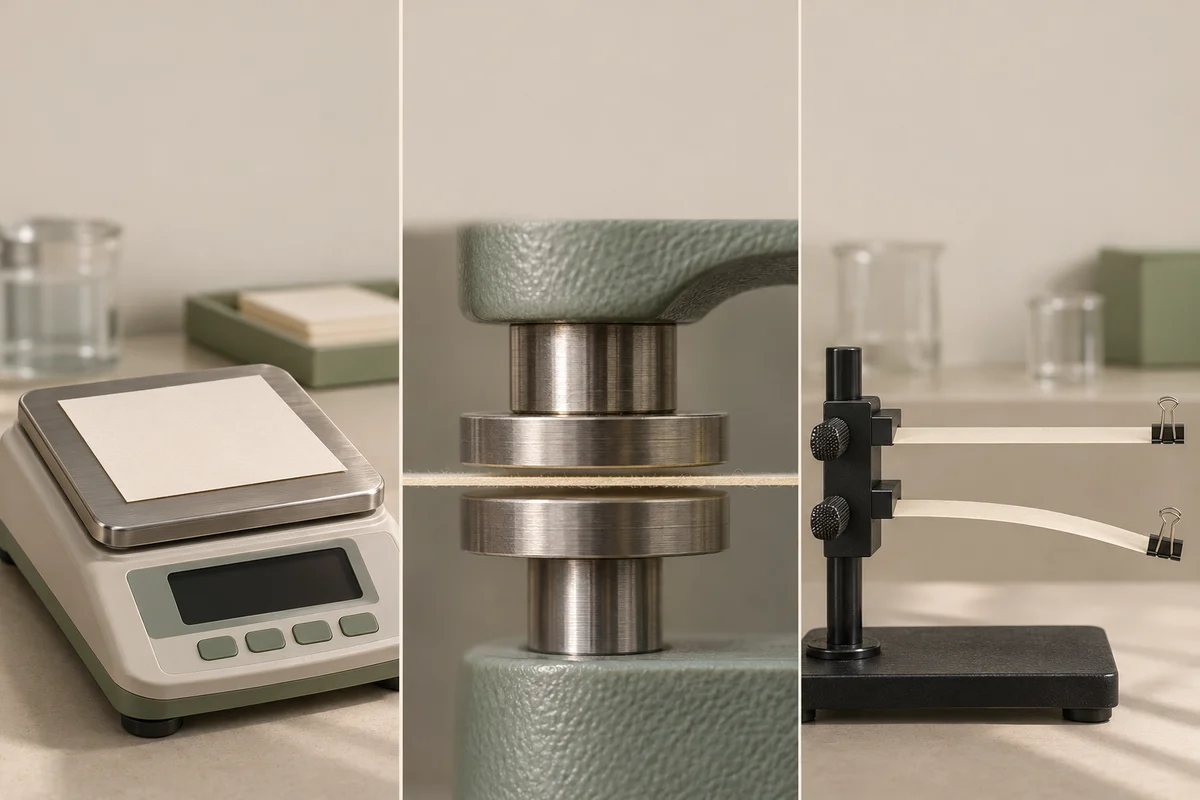
- Grammage · mass for a known area
- Thickness · distance between faces
- Stiffness · resistance to bending
AI-generated illustration of measurement principles.
Read the units and identify the layer
Grammage is normally shown in g/m². As a simple example, a 10 × 10 cm piece of 200 g/m² paper has a theoretical mass of 2 g. Thickness may be shown in µm or mm. For adhesive products, check whether a value describes the face stock alone or the complete construction with adhesive and release liner.
Compare how the paper bends
Thickness and fibre structure both influence bending. Paper can also behave differently along and across its grain. For a qualitative comparison, line up strips of equal width and length in the same grain direction, with the same overhang and load. Treat this as a visual comparison of those samples.
Quick questions
Can g/m² be converted directly to millimetres?
The conversion also requires the material’s apparent density. Read the stated thickness or measure the actual material.
Does a thicker sheet always feel stiffer?
Thickness is one factor. Fibre structure, grain direction and the material construction also affect bending.